
How it works
A few small sensors. Nothing to wear.
MyIntel notices the everyday things a person would notice if they lived there, and speaks up when something changes. Here's the whole thing, start to finish, in plain English.
The short version
Three things happen.
We put up a few small sensors
They go on walls, doors, and under the mattress. Most homes take about an hour. Nothing gets drilled, nothing gets worn, nothing needs charging.
It learns what a normal day looks like
Over the first several days it gets to know the routine: when they usually wake up, how often they're in the kitchen, how much they move around at night.
You hear about it when something changes
A fall gets someone on the phone right away. A slow change, like eating less all week, shows up in the daily update instead.
What it pays attention to
The things that go wrong quietly, before they go wrong loudly
A real emergency usually has a run-up to it. Someone eats less for a week. Sleeps badly for a few nights. Stops moving around the way they used to. MyIntel watches that whole pattern instead of waiting for one alarm to go off.
Falls
If someone goes down and doesn't get back up, the people on the contact list are told immediately. There's no button to press and no pendant to remember.
Sleep
Tossing all night, or getting up at 3 a.m. over and over, is often the very first sign that something is wrong. It shows up here before anywhere else.
Meals
When the kitchen stops getting used, meals are being skipped. That is one of the most reliable early warnings there is.
Getting around
Moving slower, or making fewer trips through the house, tends to show up in the data weeks before family notices it in person.
Daily routines
A change in bathing and everyday habits can be an early clue about an infection or something else worth a check-up.
Coming and going
Know if the front door opens at two in the morning, or if someone who normally gets out every day suddenly isn't.
The part people ask about first
Nobody is watching your mom.
This is the question we get before any other one, and it deserves a straight answer. There are no cameras in a MyIntel home. There never will be.
No cameras, ever
Nothing in the system records video, images, or audio. Nobody is ever watching your mom or dad. The sensors notice movement, not people.
Nothing to wear or charge
No pendants, no watches, no button that ends up forgotten on the nightstand. The house does the work.
You decide who sees it
Only the family members and caregivers you approve can see anything. You choose who is on the list, and you can change it whenever you want.
What you actually see
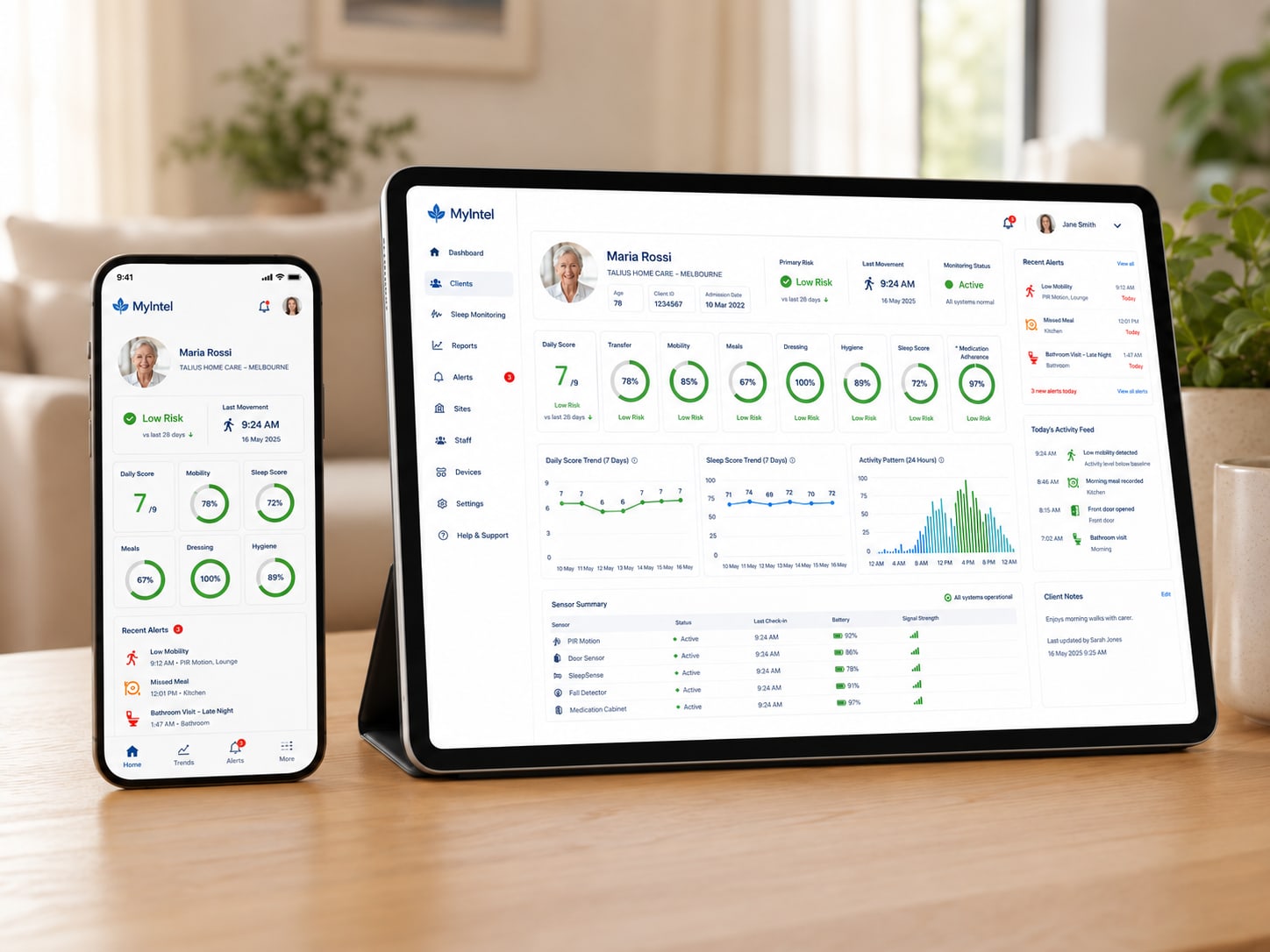
A daily update, in plain words
Most days, there's nothing dramatic to report, and that's the point. You open the app, see that they slept fine and ate breakfast, and get on with your day. When there is something worth knowing, it's right at the top.
- How they slept
- Whether they've eaten
- How much they're moving
- Anything worth a look
Where the information goes
Everyday signals in. Something useful out.
Everything the sensors pick up runs through one system, which decides what matters and who needs to know about it. The same information reaches a daughter in another state and a nurse down the hall in the form each of them actually needs.
- Motion & mobility
- Doors & entry
- Sleep
- Kitchen & meals
- Bathroom routines
- Falls
MyIntel
Turns everyday signals into something useful
- Learns this person's normal
- Spots what's out of the ordinary
- Filters out the noise
Families
A simple daily update, and a fast call when it matters
Care teams
A clear list of who needs attention first
Providers
Wellness trends that support better decisions
Under the hood
The details, for those who want them
Plenty of families never need this part, and that's fine. But if you're the one in the family who reads the manual, or you're a care provider evaluating us, here's what's actually happening.
The sensors
Battery-powered motion sensors, door contacts, a sleep sensor for the bed, fall detection, and optional extras like a medication-cabinet sensor. They mount with adhesive in most homes, so there's usually no wiring or drilling, and the batteries last months.
How the data moves
Sensors report to a small hub in the home every few seconds, around the clock. The hub uses the home's internet connection, or cellular where there isn't one. No cameras or microphones are part of the system at any point.
Building the baseline
Over the first several days the system builds a picture of that specific person's normal. There's no generic template applied to everyone. What counts as unusual for one person is an ordinary Tuesday for another.
Deciding what's worth a call
Each day gets compared against that baseline. Normal day-to-day variation is ignored on purpose, which is what keeps false alarms down. Sustained changes and sudden events are what actually generate an alert.
How alerts are routed
Alerts go out by urgency. A fall reaches the contact list immediately. A gradual change shows up in the daily summary instead, so nobody gets woken up over a late breakfast.
For care organizations
Agencies and communities get a multi-resident view, wellness scoring across daily living activities, exportable reports, and integration options so the data can reach the systems a team already uses.
Have a question we haven't answered? Call (720) 989-1123 and ask. A real person will pick up, and if we don't know, we'll tell you that too.
Founding homes
Be one of our first 50 homes
We're choosing 50 Colorado households to be MyIntel founding homes. You get in early, we set everything up for you personally, and you have a direct line to our team while we build the rest of this.
- Early access, before general availability
- We handle the setup, start to finish
- Your feedback shapes what we build next
- A direct line to our team, not a support queue
Who it's for
Older adults
who intend to stay in their own home and want it to be a safe place to do that.
Family members
who worry about a parent living alone and are tired of guessing how they're doing.
Care providers
who need to know which of their clients needs attention first, today.
Start with your home
Take the free home check to find a clear starting point before deciding what support or technology you need. There's no payment to see your results.
Prefer to talk? Call (720) 989-1123